

We used to use electricity to light up a light bulb. That was pretty cool.
Now we use electricity to light up something that talks back to us.
And that’s a bit more than cool. It’s kind of magical.
How the hell did we get from a light bulb to AI?
That’s precisely what we’ll explore in this essay.
But before we begin, it’s worth appreciating just how remarkable our arrival here really is.
Not so long ago, asking a machine a question and receiving an intelligent answer would have seemed like something out of a fairy tale. A genie in a bottle. A mirror that speaks. An oracle that answers our questions.
And now it’s here.
Yet there’s something strange about us. We’ve barely begun understanding this astonishing capability, and we’re already asking whether it can hurry up.
It seems that we strive for the extraordinary, and once we achieve it, it becomes ordinary. In our eagerness for the next discovery, we rob ourselves of the wonder of the last.
Perhaps that’s also why we tell the story of technological progress so poorly.
We can name the inventions. The light bulb, the telegraph, the transistor, the computer, the internet, the neural network. But without understanding how they relate to one another, they quickly become a shopping list without a soul.
What should be a fascinating human adventure becomes a collection of disconnected events.
But what if we looked at these discoveries differently? Not as separate inventions, but as moments in one unfolding human journey?
What would that reveal about us?
Let’s find out.
1. The Jester Who Possessed the Power of the Gods
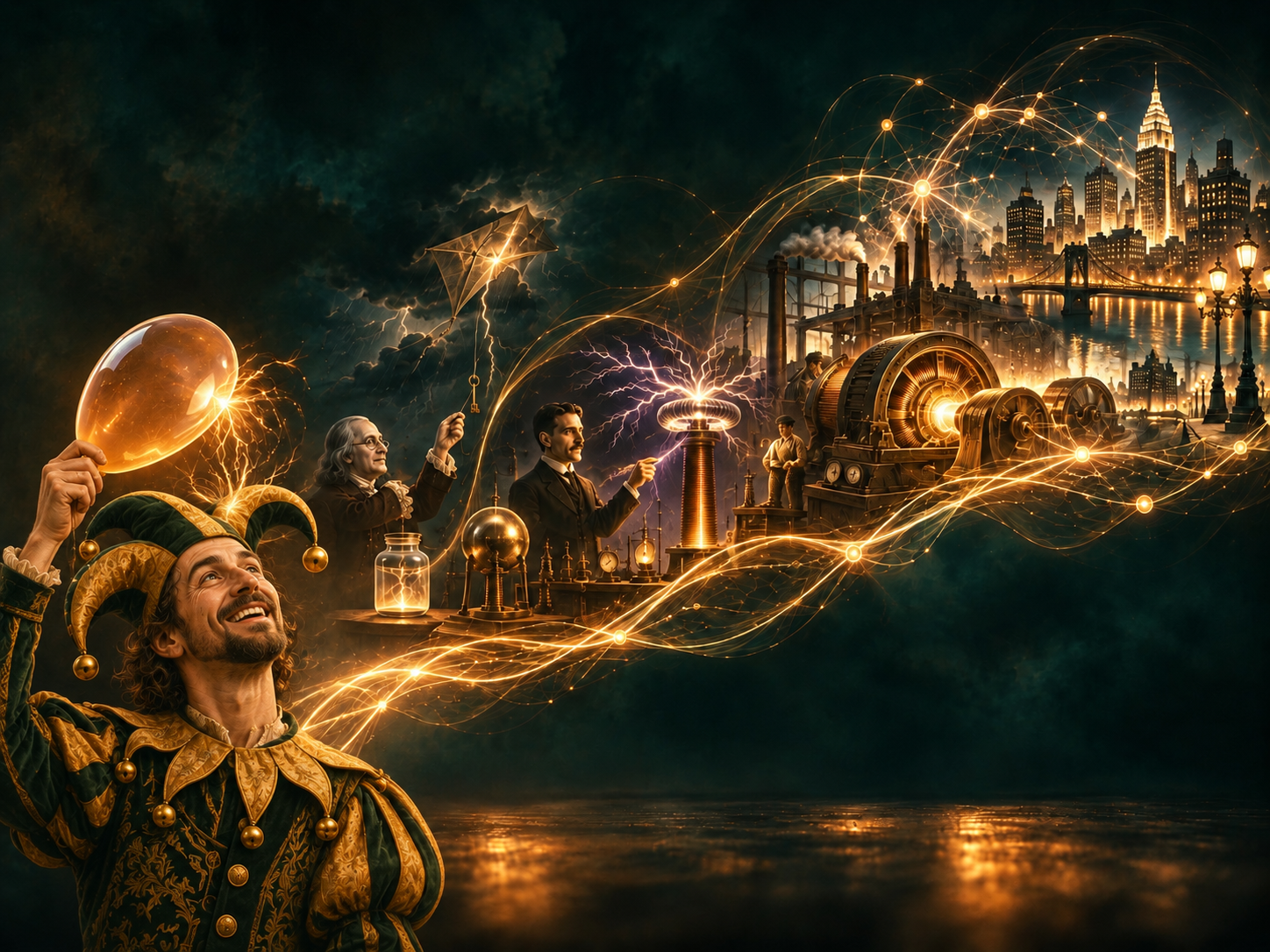
Our relationship with electricity began long before the light bulb.
For centuries, we were fascinated by its strange behaviour. We produced sparks, made objects attract one another, and entertained ourselves with experiments that seemed almost magical.
We still do.
Rub a balloon against your hair and stick it to a wall. A small victory for electricity. A rather unfortunate outcome for your hairstyle.
For much of our early relationship with electricity, that’s essentially what it was to us. A jester. Something we could play with, experiment with, and use to entertain an audience.
But as our understanding deepened, we began to realise that this curious force could do something far more useful.
It could do work.
We had already learned to mechanise physical labour through coal and steam. Electricity offered a more flexible way to deliver and control power. It could operate machinery, illuminate cities, and drive equipment with remarkable precision.
And as we learned to harness it, electricity transformed the world around us.
It became so closely associated with power that today we use the words almost interchangeably.
And think about what had just happened.
We had learned to harness a force once associated with the powers of the gods, celebrated across Greek, Norse, Japanese, and Vedic traditions.
Whether Zeus, Thor, Raijin, or Rudra, we had long imagined divine beings commanding the forces of thunder and lightning.
Now we had learned to harness that power ourselves.
Our little jester, it turned out, possessed the power of the gods.
But electricity wasn’t just powerful.
It was also remarkably fast.
And that opened an entirely different possibility.
2. When Electricity Became a Messenger
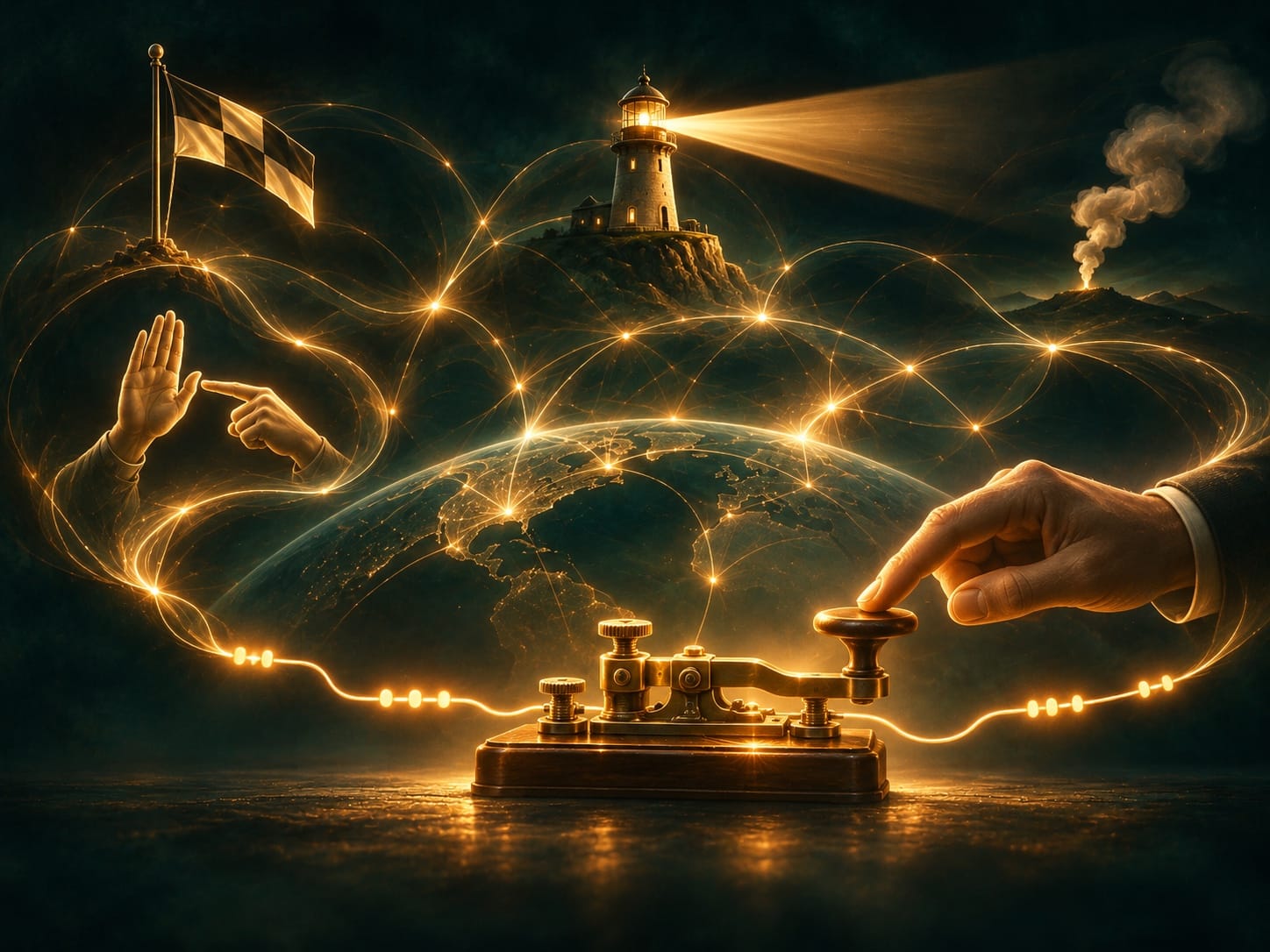
Communicating across distances has always been essential to human society.
Long before electricity, we had learned to communicate through signals.
We used flags to convey instructions during battles. Lighthouse lights warned sailors and helped them navigate. Some Indigenous communities used smoke signals to communicate across distances.
Even sign language demonstrates the same underlying principle.
A movement or signal might appear meaningless to someone unfamiliar with it, but to those who understand its meaning, it communicates something quite specific.
The important thing isn’t the signal itself.
It’s the meaning we’ve agreed to give it.
Now imagine applying that principle to electricity.
What if we could use electrical pulses to represent letters and words?
That was the idea behind the electric telegraph, which was already developing before electric lighting became widespread.
We pressed a key, electrical signals travelled along a wire, and someone at the other end interpreted the pattern.
The electricity didn’t know whether the message announced a wedding, a war, or a shipment of potatoes.
It simply carried the signal.
And because electrical signals travelled incredibly quickly, messages that once took days or weeks could now arrive in moments.
Think about what we had accomplished.
We had already learned to harness a force associated with divine power. Now we had reproduced another ability celebrated in mythology: communicating across vast distances almost instantly.
Like Hermes and Iris, the swift messengers of mythology, we could carry messages with lightning speed.
But the significance of this discovery went far beyond the telegraph.
We had established a principle that would eventually become fundamental to modern communication: information could be represented through signals, transmitted across distances, and reconstructed by someone—or something—at the receiving end.
The same underlying idea would later help make computer networks, the internet, and communication between AI systems possible, although through far more sophisticated technologies.
Our jester had become a messenger with capabilities once attributed to the gods.
And that raised another question.
If electricity could carry information, could we make it do something with that information?
Could we use it to reason?
3. When We Gave Logic a Physical Form
Human beings had been reasoning for thousands of years.
We had developed mathematics, philosophy, and systems of logic to analyse problems and arrive at conclusions.
We had even reproduced aspects of reasoning mechanically, using gears and other components to perform calculations.
But electricity offered us something remarkable.
We could represent logic physically, through electrical circuits.
Now, think about that for a moment.
Computers perform incredibly complex logical operations. Yet the building blocks of that complexity are surprisingly simple.
How simple?
Simple enough that we use the same underlying logic every day without ever using a computer.
And just by understanding how those simple logical relationships work, we can begin to understand how a computer works.
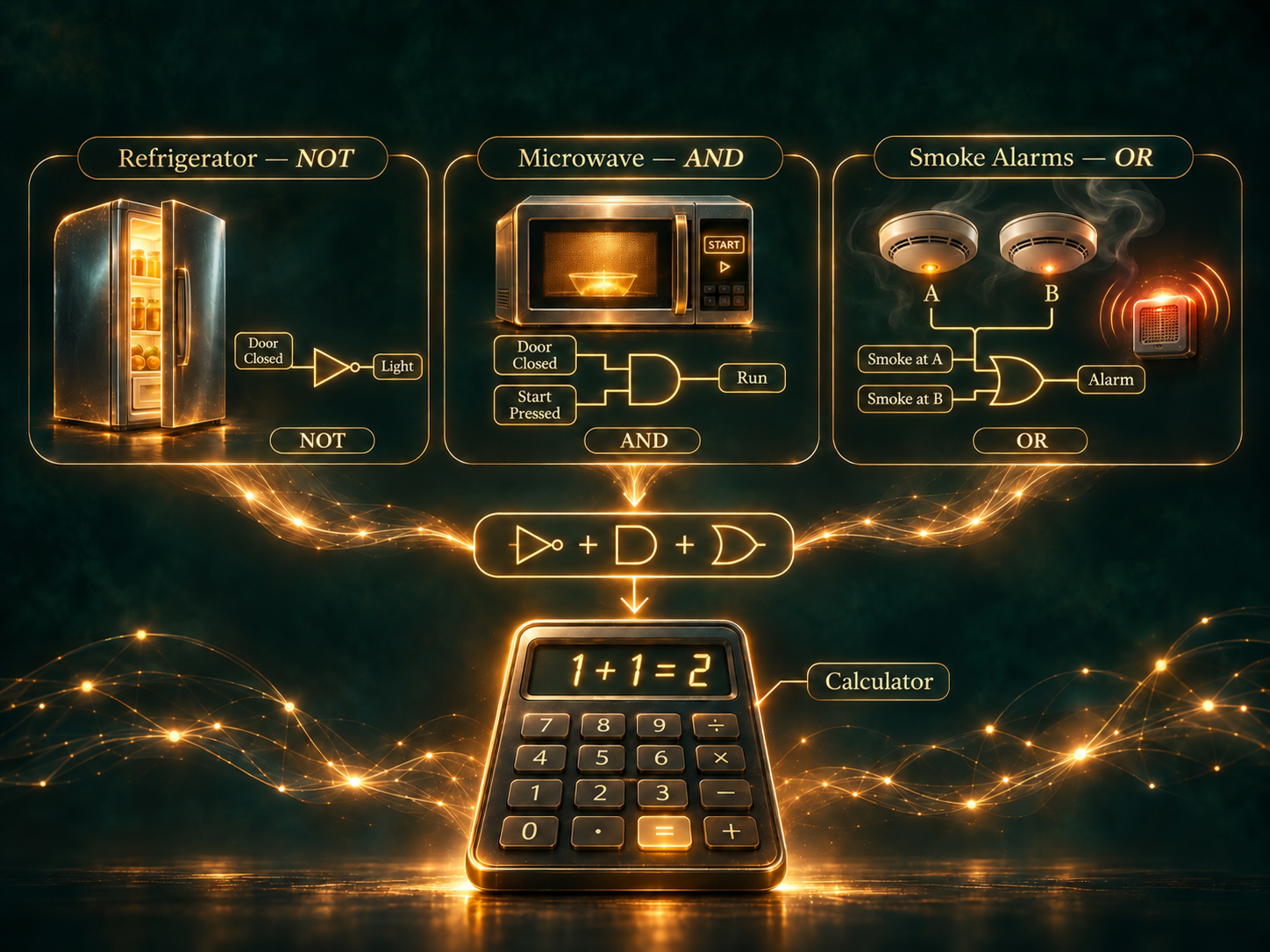
Consider three familiar devices: a refrigerator, a microwave, and a connected smoke alarm.
Each uses electrical circuits to perform different tasks. But what is the logic behind those circuits?
Let’s start with the refrigerator.
When we close the door, the light turns off. When we open it, the light turns on.
What’s the logic governing the light?
The light comes on when the door is NOT closed.
Now consider the microwave.
With the cooking time set, we close the door and press Start.
What’s the logic governing whether it begins cooking?
The microwave can start cooking when the door is closed AND the Start button is pressed.
That’s another logical relationship.
And finally, consider a connected smoke-alarm system.
We have a detector in the kitchen and another in the hallway.
What’s the logic governing whether the warning sounds?
The alarm sounds when smoke is detected in the kitchen OR smoke is detected in the hallway.
There we have it.
NOT. AND. OR.
Three simple logical relationships that can be represented through electrical circuits.
And notice something else about these examples.
The light is either on or off. The microwave is either cooking or not. The alarm is either sounding or silent.
Each has two possible states.
In digital computing, we represent two states using 0 and 1. We call this binary.
For simplicity, think of 0 as off and 1 as on.
And by arranging these zeros and ones in different combinations, we can represent the numbers we use every day.
That gives us something rather useful.
We can represent information through binary states, and we can use logical circuits to perform operations on those states.
And here’s where it becomes fascinating.
AND, OR, and NOT are enough to express all the logical operations used in digital computing.
The circuits inside our household appliances aren’t necessarily identical to the logic gates inside a computer. But the logical principles they illustrate are the same.
And when we combine these basic operations, we can create others.
For example, combining NOT with OR gives us NOR. Combining NOT with AND gives us NAND. Other arrangements produce operations such as XOR, or exclusive OR.
These are known as logic gates.
We can combine gates into larger circuits, and those circuits into increasingly sophisticated systems.
Nature offers us a beautiful example of this principle.
Consider DNA.
The genetic information of living organisms is encoded using just four chemical bases: adenine, guanine, cytosine, and thymine.
Four building blocks.
Yet their different sequences help give rise to the astonishing diversity of life around us.
The complexity doesn’t come from having countless different building blocks. It comes from how a small number of them are organised.
And something similar happens with logic.
A handful of fundamental operations, combined in different arrangements, can produce an enormous variety of logical functions.
Add memory and other components, and we can build something like a calculator.
Imagine handing one to an ancient king.
He enters two enormous numbers, presses a button, and receives the answer almost instantly.
To him, it might seem like sorcery.
But what he’s witnessing is simply those basic logical operations working together in more complex arrangements.
And a computer extends that principle much further.
Using remarkably simple logical operations, we can create computers capable of performing astonishingly complex tasks.
But that raises another question.
How do we tell these machines what to do?
And could we make one computer perform many different tasks, simply by changing its instructions?
4. The Evolution of Instructions
Think about a calculator.
We enter numbers, select an operation, and the machine follows our instructions.
But imagine wanting a machine to perform thousands of different operations in a particular sequence.
We couldn’t reasonably sit there pressing buttons for every step.
We needed a better way to provide instructions.
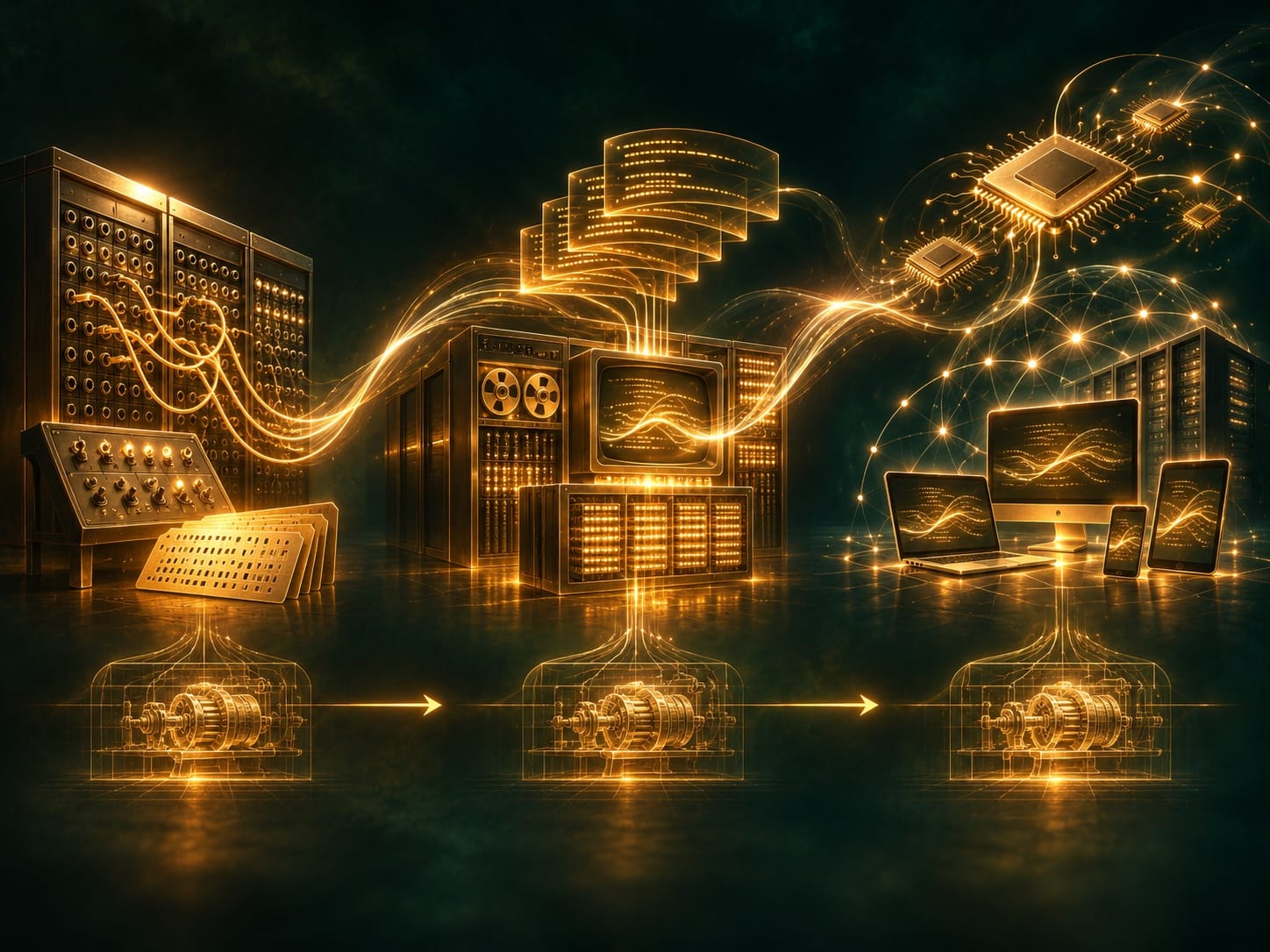
In some early computers, programming involved physically rearranging wires and adjusting switches. Other machines used punched cards or tape to supply coded instructions.
But eventually, we asked ourselves a rather clever question.
What if we could store those instructions inside the computer itself?
Instead of changing the physical machinery or feeding it a new sequence of cards, we could write software that the computer could retrieve from its own memory.
That was the breakthrough of stored-program computing.
By changing the software, we could change what the machine did.
The same computer could calculate wages, analyse scientific data, design a building, or play a game.
We didn’t need a different machine for every purpose.
We could simply change the program.
Meanwhile, the machinery itself was undergoing a remarkable transformation.
Remember the refrigerator, microwave, and smoke alarm?
Each uses switches or electronic controls to respond to particular conditions.
At its simplest, a switch allows us to turn an electrical connection on or off.
And what makes switching so powerful in computing isn’t the size of an individual switch.
It’s how many switching operations we can organise together.
Early computers relied on bulky switching components, including mechanical relays and electronic valves.
But then we developed transistors.
A transistor could act as a tiny electronic switch, controlled by an electrical signal rather than by our hands or moving mechanical parts.
And as we learned to manufacture them on increasingly smaller scales, we could fit enormous numbers into a single chip.
Eventually, billions.
Computers became faster, smaller, and more powerful.
We also began connecting them through networks, eventually creating the internet, which allowed computers across the world to exchange information.
And as miniaturisation continued, machines that once occupied entire rooms eventually fitted into our pockets.
We now had powerful, programmable, interconnected computers capable of performing an astonishing variety of tasks.
But beneath all that sophistication, the principle remained familiar.
The circuits performed logical operations. The software directed how those operations were used.
But that was also its limitation.
Traditional software depended on instructions we had explicitly programmed, or rules we had given the machine for handling different situations.
It could perform complicated tasks, but what happened when it encountered something we hadn’t anticipated?
Could we develop programs that didn’t need us to specify every possibility in advance?
Could we make machines do things we hadn’t individually programmed them to do?
Could we make them learn?
Could we make them imagine?
5. When We Looked in the Mirror
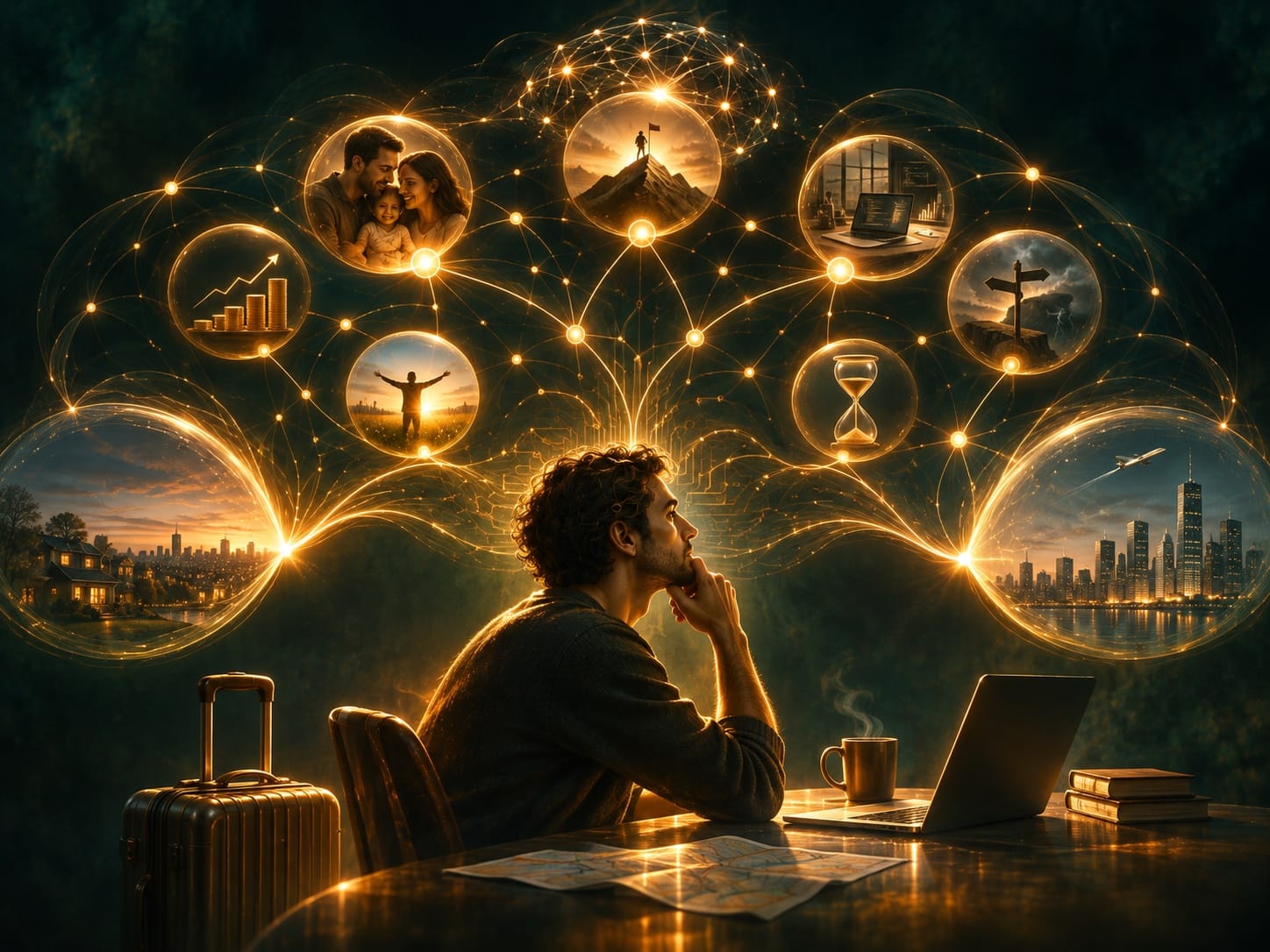
Imagine trying to write a program that could reproduce the way we think.
How could we anticipate every situation we might encounter, every possibility we might consider, and every decision we might make?
The number of instructions and exceptions would become overwhelming.
Yet somehow, we navigate unfamiliar situations every day, without having been specifically programmed for each one.
How do we actually do it?
Well, think about how we make decisions.
We draw upon what we know, observe what’s happening around us, consider different possibilities, and anticipate what might happen next.
We know this intuitively from our own experience, and psychology has long studied how these processes influence our behaviour.
Consider something familiar.
Perhaps we’ve been offered a job in another city.
The salary is attractive. But what about our family, our ambitions, our responsibilities, and our long-term happiness?
We begin weighing possibilities.
Some considerations matter enormously. Others matter very little.
Our experiences influence how much importance we give them, and we imagine different outcomes before deciding what to do.
Ultimately, our decision reflects the combined influence of those considerations.
And when we experience the consequences, we learn.
What mattered enormously yesterday may matter less tomorrow.
So although human thinking involves far more than this, we can recognise a useful pattern.
We draw upon information, weigh possibilities, make predictions, and learn from experience.
Now comes the interesting question.
Could we reproduce something similar in a computer?
What if we could represent information and different possibilities mathematically?
What if we could assign them weights, allowing some to influence an outcome more than others?
And what if those weights could change as the computer learned from examples?
We wouldn’t need to write instructions for every possible situation.
Instead, we could build software that learned which patterns mattered and how to respond to them.
And that’s where artificial neural networks entered the picture.
Inspired by aspects of how neurons interact in our brains, we developed mathematical networks that assign different weights to incoming information.
Just as different considerations influence our decisions, different numerical weights influence a network’s outputs.
And just as our experiences influence how we make future decisions, these networks can learn through training.
We provide examples, compare the network’s outputs with the desired results, and adjust its weights.
Over time, it becomes better at recognising patterns and responding to unfamiliar information.
We hadn’t replaced the underlying logical circuits.
We had built something on top of them that could learn how to weigh information.
The idea wasn’t new.
Decades earlier, psychologist Frank Rosenblatt had developed an early learning system called the perceptron, inspired by aspects of how the brain works.
But the technology was limited. We needed better training methods, more information, and vastly greater computing power.
As those capabilities improved, neural networks became increasingly sophisticated.
They learned relationships across language, images, sound, and other forms of information.
And once machines could learn these relationships, another possibility emerged.
Could they use what they had learned to create something new?
6. When Machines Learned to Imagine
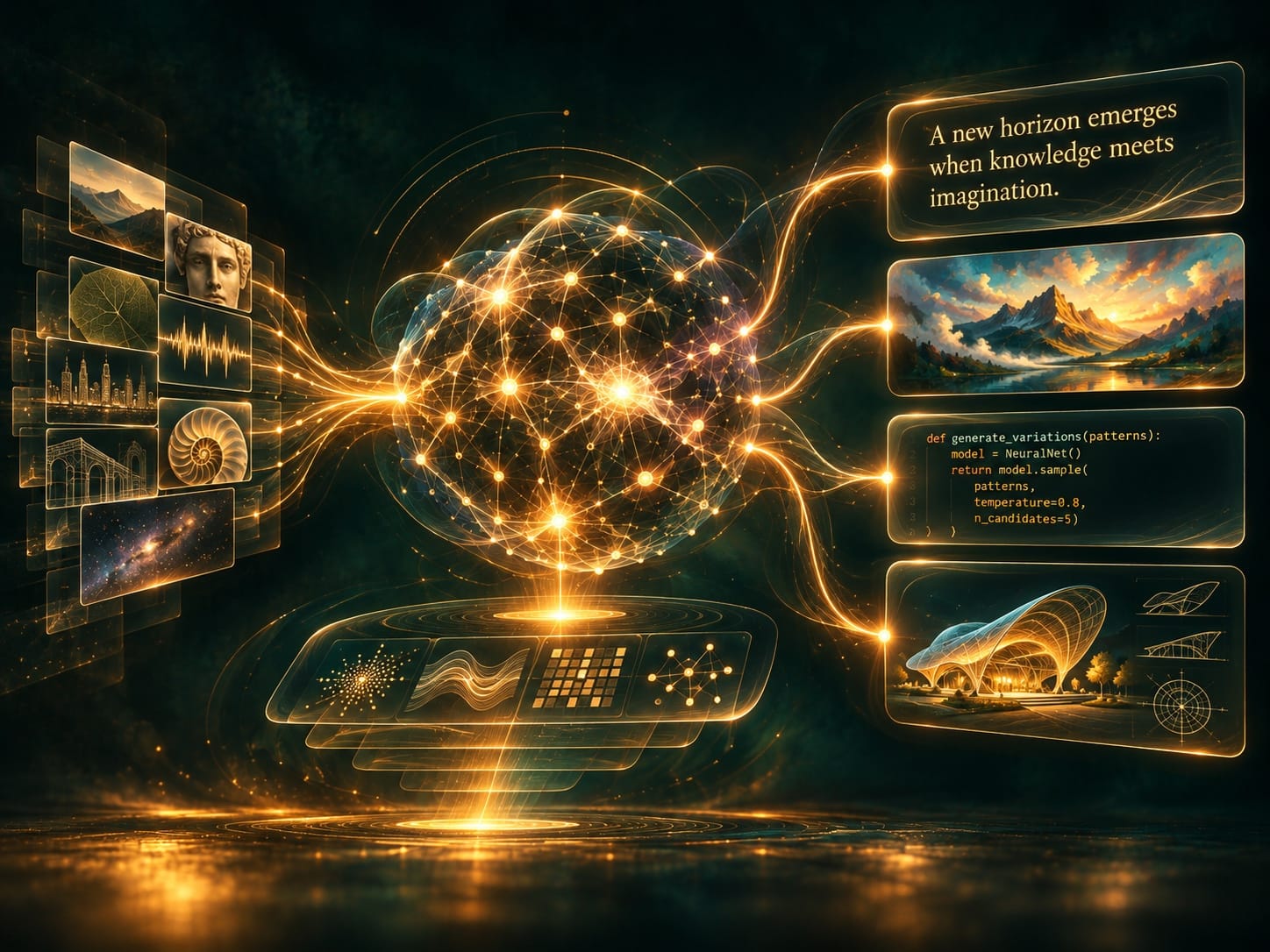
Think about what happens when we imagine something.
A writer creates a character who has never existed. An inventor combines existing knowledge to design something nobody has built.
We draw upon what we know, recognise relationships, and combine them in new ways.
Could a machine do something similar?
Well, we had already developed systems that could learn patterns and relationships from information.
But recognising a pattern is one thing.
What if we could use those learned patterns to generate something?
Instead of asking a neural network simply to recognise what’s in an image, could we ask it to create an image?
Instead of asking it to analyse a sentence, could we ask it to produce one?
And rather than telling it exactly what to produce, could we allow it to use what it had learned to construct something new?
That was the next step.
By developing more sophisticated neural networks and training methods, we created systems capable of generating new outputs from learned relationships.
A sentence nobody had explicitly programmed. An image nobody had previously drawn. A possible solution to an unfamiliar problem.
And eventually, we arrived at modern generative AI.
We could ask a machine a question, explore an idea, create an image, write software, or work through a problem.
And the machine could respond in ways that weren’t individually written into its program beforehand.
It had learned patterns and could use them to generate new possibilities.
That doesn’t establish that a machine imagines as we do.
But it does demonstrate something remarkable about what imagination allows us to accomplish.
Pair that capability with immense computing power, sophisticated software, and access to enormous amounts of information, and we begin to understand why AI appears so impressive.
Our calculating genius had become something resembling a sage.
An imperfect sage, admittedly.
It still glitches, hallucinates, and occasionally produces remarkably confident nonsense.
But many of its limitations are being reduced as the technology improves.
And think about what that represents.
Throughout history, we had imagined divine beings possessing extraordinary powers of knowledge, intellect, and wisdom. We created figures who could answer difficult questions, understand hidden relationships, and reveal possibilities beyond ordinary human understanding.
And now, through our own ingenuity, we had built machines capable of reproducing aspects of those abilities.
Not divine beings, of course. But capabilities that earlier generations might well have considered miraculous.
Quite a journey.
7. The Journey Beneath the Journey
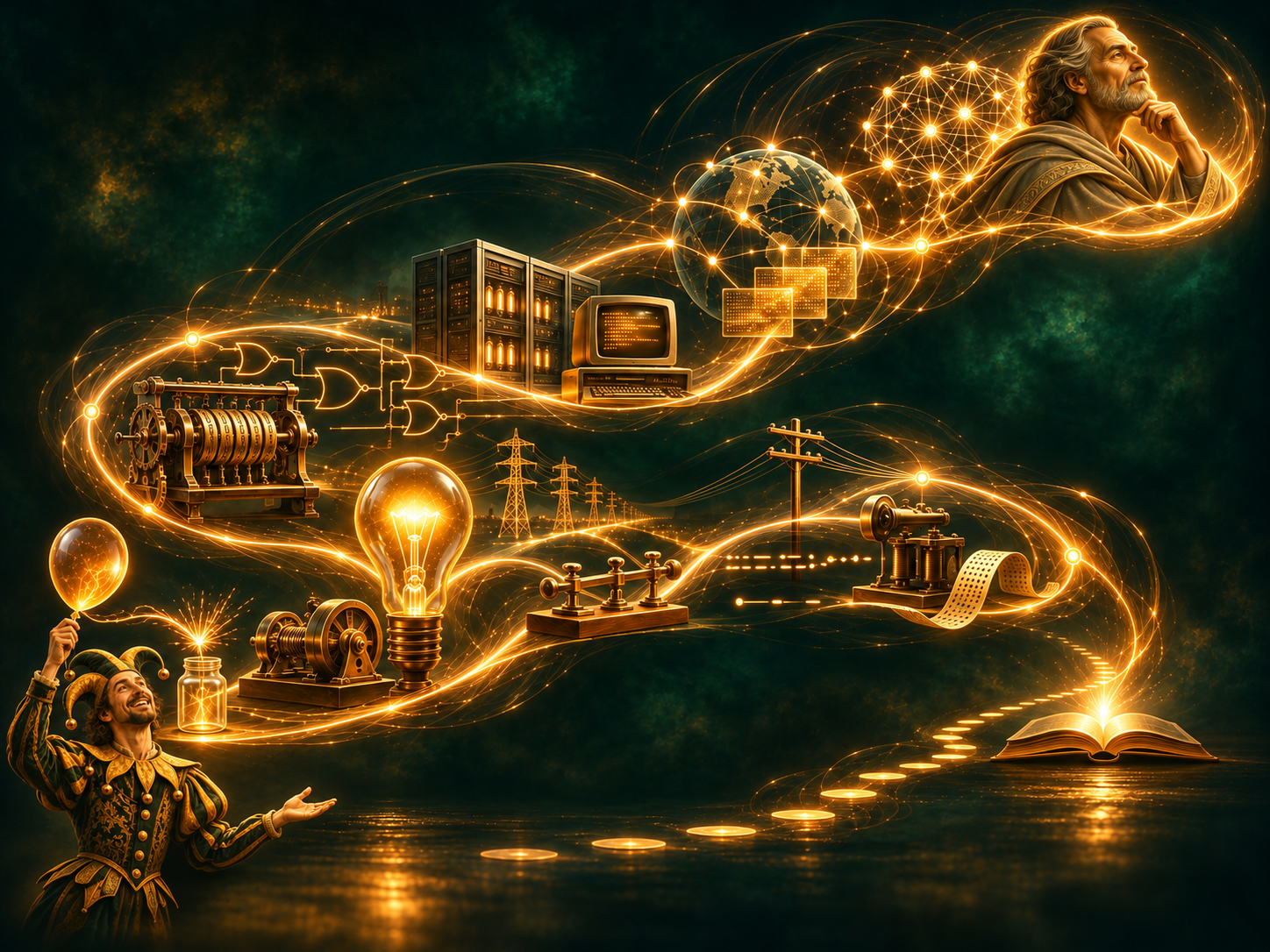
There’s something almost archetypal about this story.
Our journey with electricity began with the fool, the jester, playing with something whose remarkable potential we didn’t yet understand.
Through curiosity came discovery. Through discovery came understanding. And through understanding came mastery.
The fool became the apprentice, the apprentice became the master, and eventually the master became the sage.
It’s a pattern we recognise in our own development and in the things we create.
But look at this journey from a higher vantage point, and something even more interesting emerges.
What have we actually been doing?
We’ve been finding ways to reproduce more and more of our own capabilities outside ourselves.
We began by extending our physical capabilities. Then our ability to communicate, calculate, reason, learn, and eventually generate new possibilities.
Capabilities we once associated with the powers of gods, messengers, and sages have increasingly become part of our technological world.
And there’s another pattern here.
We didn’t invent electricity. And we didn’t invent the fundamental relationships that make logic possible.
The forces of nature were already here. So were the relationships we eventually learned to describe through mathematics and logic.
What changed was our understanding of how to bring them together.
Electricity, logic, circuits, instructions, memory, information, and mathematical models.
Individually, each offered particular possibilities.
But when we brought them together, we created capabilities far greater than those of the individual components.
We integrated the parts, and through that integration, something new became possible.
And each new possibility opened the door to another discovery.
That is how we travelled from the light bulb to AI.
It was a journey from the jester to the sage.
A journey from fragmentation into integration.
And now that we can see the journey, it leaves us with a rather fascinating question.
If we’ve been finding ways to reproduce more and more of ourselves through technology, what remains uniquely human?
And perhaps more importantly, what does that mean for where we go next?
That is where the second essay in this series will take us.


